
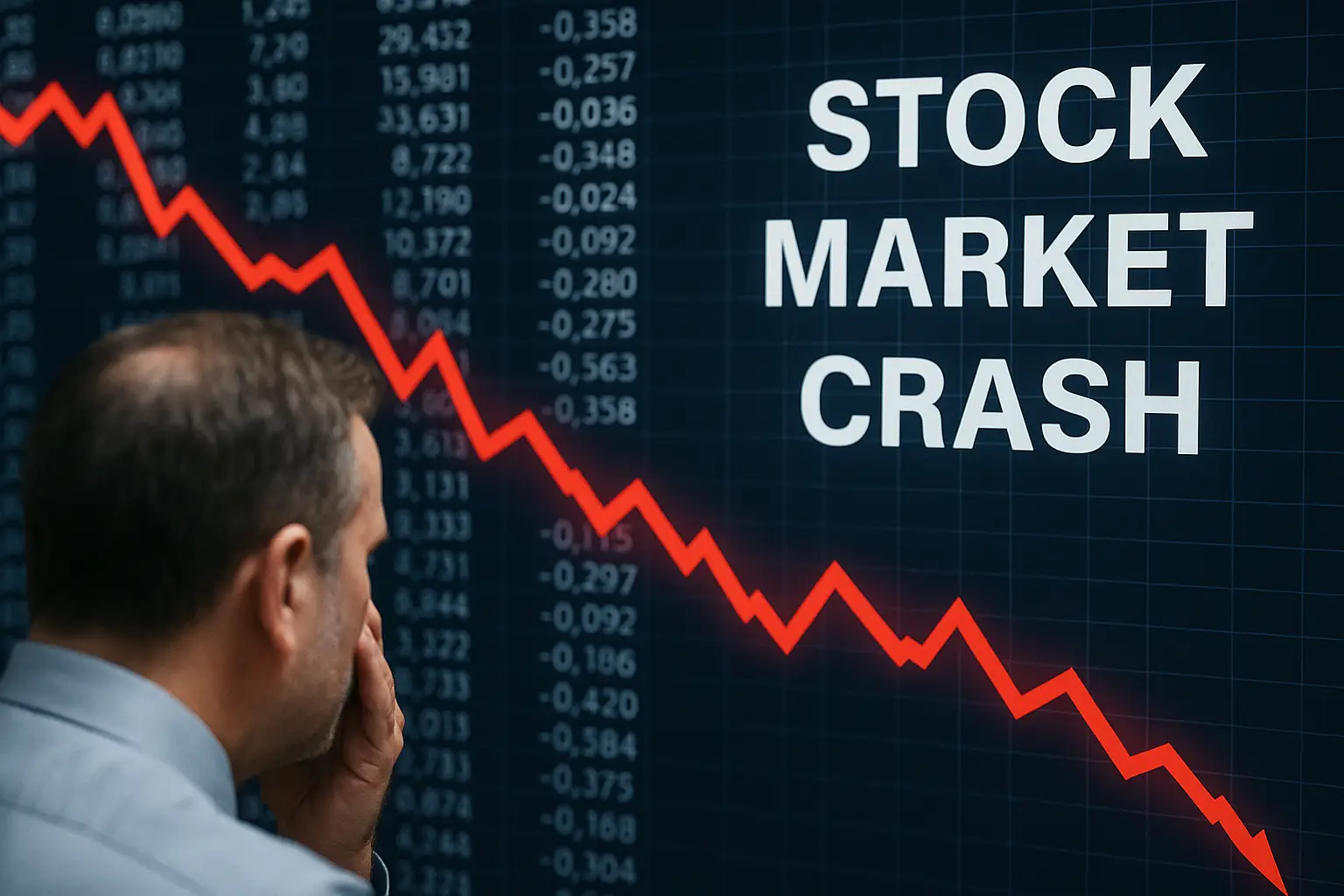
A stock market crash can feel like a thunderstorm that comes out of nowhere. One day the market is rising, everyone is optimistic, and the next day prices start falling so fast that even experienced investors begin to panic. If you’re someone who has ever opened your trading app during a market crash, you know that sinking feeling in your stomach.
And trust me—every investor has been there.
The important thing to understand is this: a stock market crash is not the end of the world, and it is not the end of your investing journey.
Crashes are a natural part of market cycles. They are painful, yes, but they also create some of the best opportunities for long-term wealth building.
In this human-style, easy-to-understand article, we’ll break down exactly what a stock market crash is, why it happens, what history teaches us, and how you can protect your investments when things get rough.
Let’s get into it.
Source: Federal Reserve – Historical Interest Rate Data
What Is a Stock Market Crash? (Simple Explanation)
A stock market crash is a sudden and sharp decline in stock prices, usually 10–20% or more within days or weeks.
This is not the same as a normal correction, which is slow and healthy.
A crash is dramatic. It’s emotional. It spreads fear like wildfire.
Crashes happen when:
Investors lose confidence
Negative news shocks the market
Big investors begin selling
Retail investors panic and follow
Think of it like a crowd running out of a theatre after someone shouts “fire.” Everyone starts running without even checking what’s actually happening.
Why Do Stock Markets Crash? (Real Causes, Real Examples)
If you study history, you’ll see that crashes don’t happen randomly. They follow patterns. And most crashes are caused by a mix of economic, emotional, and global factors.
1. Economic Slowdowns or Recession Fears
When the economy weakens:
Companies earn less
Jobs become uncertain
Consumers spend less
All of this reduces corporate profits, and investors react by selling.
Example:
Before the 2008 crash, the U.S. economy showed early warning signs such as falling home prices, a spike in loan defaults, and tightening of bank credit.
These small signals eventually erupted into the biggest financial crisis of this generation.
2. Excessive Speculation and Market Bubbles
A bubble happens when stock prices rise too fast without real earnings growth. People start buying just because prices are going up.
This is dangerous because once confidence breaks, the bubble bursts.
Real Example:
In the Dot-Com Bubble (2000), thousands of tech companies had no profits—just big promises.
NASDAQ later crashed by 78%.
Speculation is like stretching a rubber band—it snaps when pulled too far.
3. High Inflation and Interest Rate Hikes
When inflation shoots up, the cost of everything increases—raw materials, transport, loans, salaries.
So companies earn less.
Then central banks step in and raise interest rates to control inflation.
Higher interest rates:
Make loans expensive
Reduce business expansion
Lower profit expectations
Reduce stock valuations
During 2022–23, tech stocks fell nearly 30% due to aggressive rate hikes.
4. Global Conflicts and Political Instability
Geopolitical tensions can shake markets instantly.
Wars, sanctions, border conflicts, or political instability create uncertainty.
Example:
In February 2022, when Russia invaded Ukraine, global stock markets fell sharply within days.
Investors fear what they cannot predict.
5. Black Swan Events (Extremely Rare but Powerful)
These are unpredictable events that create massive global impact.
Example: COVID-19 (2020)
Within just a few weeks:
Dow Jones recorded one of its worst single-day drops ever
Nifty50 fell around 38%
Global trade froze
Economies shut down overnight
This crash wasn’t caused by economic weakness—it was caused by pure global shock.
Major Stock Market Crashes in History (And What We Learn From Them)
To understand market crashes, we MUST understand their history. Almost all crashes teach the same lessons.
Source: World Bank – Global Economic Indicators
1. The Great Depression Crash (1929)
Dow Jones fell nearly 90%
Millions lost jobs
Companies collapsed
Recovery took over a decade
Lesson: When speculation is high and regulations are weak, bubbles explode.
2. Black Monday (1987)
In one single day, U.S. markets fell 22%
This spread to markets around the world
Caused partly by automatic computer-based selling
Lesson: Technology increases market speed—both up and down.
3. Dot-Com Crash (2000–2002)
Tech stocks rose insanely fast during the 90s
Investors were buying websites, not businesses
NASDAQ eventually dropped 78%
Lesson: A company needs earnings, not hype.
4. Global Financial Crisis (2008)
Banks gave risky loans
Home prices dropped
Mortgage defaults exploded
Big banks nearly collapsed
S&P 500 fell 57%
Lesson: Too much debt anywhere can crash the entire global system.
5. COVID-19 Crash (2020)
Travel stopped
Businesses closed
Supply chains froze
Stock markets collapsed globally
But interestingly, it was also one of the fastest recoveries ever.9
Lesson: Crashes are unpredictable, but recovery is powerful and consistent.
Source: SEBI – Annual Reports & Market Data (India)
Warning Signs That Often Come Before a Crash
Although no one can perfectly predict the exact day of a crash, there are patterns that appear again and again.
1. Stocks Become Overvalued
When PE ratios rise far above normal, it signals danger.
Before the 2000 crash, many tech companies traded at PE ratios of 100+.
2. Too Much Euphoria in the Market
When “everyone is making money,” and beginners think investing is easy, that’s a red flag.
Examples:
People taking loans to buy stocks
Viral social media trading tips
Overconfidence among retail traders
Euphoria always comes before corrections.
3. Excessive Corporate or Consumer Debt
Heavy debt makes companies extremely vulnerable.
A small slowdown can push them into bankruptcy.
This was a major cause in 2008.
4. Rapid Interest Rate Hikes
Fast rate hikes slow down the economy, reduce borrowing, and hit high-growth stocks hard.
5. Negative Global News
Markets react instantly to:
War
Terror attacks
Pandemics
Global sanctions
Large corporate collapses
These often trigger short-term panic selling.

How a Stock Market Crash Affects the Real Economy
A big crash doesn’t stay limited to stock markets.
It affects:
Job markets
Business expansion
Consumer spending
Government revenue
Corporate earnings
When stock markets fall, people feel poorer — so they spend less. Businesses earn less. This slows down economic growth.
But remember: recessions are temporary; economic cycles move forward.
Also read: Black Friday Sales 2025: Your Ultimate Guide to the Biggest Shopping Event of the Year
How Investors Can Protect Their Money (Practical, Real-World Tips)
Over the years, the biggest difference between successful investors and failed investors is how they behave during crashes.
1. Build a Strong Emergency Fund
Always keep 3–6 months of expenses saved separately.
This ensures you never need to sell your investments in panic.
2. Diversify Properly
A healthy portfolio should include:
Large-cap stocks
Mid-cap stocks
Debt funds or bonds
Gold
Index funds
Some international exposure
Diversification reduces risk dramatically.
3. Avoid Penny Stocks and Hype Stocks
Stocks that rise 20–30% quickly can fall 50% even faster.
Stick to companies with:
Stable earnings
Low debt
Strong leadership
Long-term growth potential
4. Use SIPs (Systematic Investment Plans)
SIPs help you buy more units when prices fall — reducing your average cost.
This is one of the best tools during market crashes.
5. Don’t Check Your Portfolio Every Day
Market crashes are emotionally painful.
Checking your portfolio every few hours will only increase fear and create bad decisions.
6. Think Long-Term, Not Short-Term
Real wealth is created over:
5 years
10 years
20 years
Not 5 days.
Short-term fear should never override long-term goals.
7. Keep Some Cash for Opportunities
Crashes create once-in-a-decade opportunities.
Many great companies become extremely undervalued.
Smart investors buy when others panic.
Also read: Hong Kong Fire Claims 44 Lives – Hundreds Still Missing in Devastating Tai Po Tragedy
What Global Investment Legends Say About Crashes
Warren Buffett:
“Be fearful when others are greedy and greedy when others are fearful.”
Benjamin Graham:
“In the short run, the market is a voting machine, but in the long run, it is a weighing machine.”
Rakesh Jhunjhunwala:
“If you believe in India’s growth story, volatility is your friend.”
These quotes are repeated for years because they reflect real experience, not theory.
Do Markets Always Recover? (Data Says YES)
Let’s look at historical returns:
The S&P 500 has returned around 9–10% annually for 50+ years
The Sensex has returned around 10–12% annually since its launch
And these returns include ALL crashes:
1987
2000
2008
2020
Every crash was temporary.
Every recovery set a new all-time high later.
This is why long-term investors always win.
Should You Sell During a Crash?
For 99% of investors, the answer is NO.
Selling during panic locks in losses permanently.
Sell only if:
Company fundamentals collapse
There is fraud
Management becomes unreliable
Debt becomes unsustainable
Otherwise, holding or adding more is better.
Also read: Tata Sierra 2025: The Iconic SUV Returns with Modern Avatar
Is Another Crash Coming Soon?
Nobody can give an exact date — not analysts, not economists, not billionaires.
But we can identify risk factors:
High inflation
Weak corporate earnings
Global tensions
Overvalued sectors
Sharp interest rate hikes
Recession fears
Smart investors prepare.
Panicked investors predict.
Conclusion
A stock market crash is scary, emotional, and confusing — but it is also a powerful reminder that markets move in cycles. Every crash in history has eventually led to recovery and new highs.
The investors who stay patient, diversified, and disciplined not only survive crashes — they benefit from them.
With the right strategy, a crash becomes an opportunity, not a disaster.
Crashes are temporary.
Good companies are permanent.
Long-term growth always wins.

Sundhanshu Pathania works as a content analyst and writer at Multi News Hub. He focuses on analyzing news trends and writing articles related to global affairs, technology updates, sports, and trending topics.
His role involves reviewing multiple news sources, understanding search behavior, and presenting information in a clear, reader-friendly format. He contributes to the platform by researching topics and ensuring factual clarity in published content.
3 thoughts on “Stock Market Crash: Causes, Warning Signs, History, and How Investors Can Protect Their Money”