
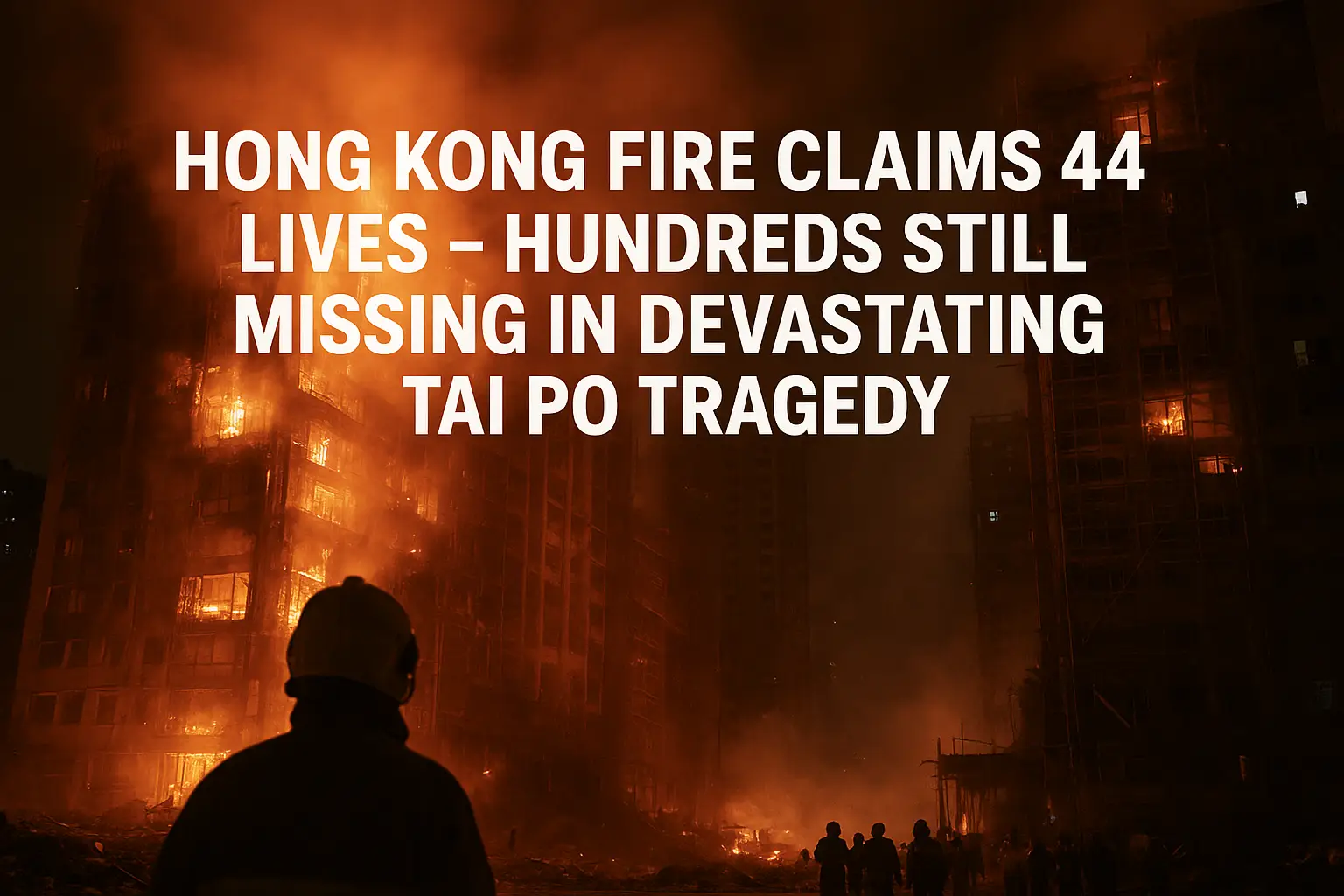
The city of Hong Kong woke up Thursday morning to heartbreak and horror. A massive fire that began on Wednesday afternoon at the Wang Fuk Court housing complex in Tai Po district has claimed at least 44 lives. Another 279 people remain missing. This Hong Kong fire has become the deadliest residential blaze the city has witnessed in more than three decades, leaving families desperately searching for loved ones and an entire community in shock.
The flames didn’t just consume buildings. They tore through lives, memories, and the sense of safety that residents once felt in their homes.
As rescue teams continue working tirelessly through debris and smoldering rubble, one question echoes through the streets: How could this happen?
Video Source: BBC News
👥 Reported by: Hafsa Khalil & Kathryn Armstrong
© BBC. All rights reserved. This video is used for educational and news commentary purposes only.
What Happened in the Hong Kong Fire?
The Hong Kong building fire news started spreading around 2:51 PM on Wednesday, November 26, 2025. What began as a routine afternoon quickly turned into a nightmare for thousands of residents living in the Wang Fuk Court complex.
The fire broke out at one of the residential towers in Tai Po, a suburban area in northern Hong Kong near the border with mainland China. Within minutes, the blaze spread rapidly across multiple buildings.
By 3:34 PM, authorities upgraded the fire alarm to level four. Less than three hours later, at 6:22 PM, it reached the highest emergency classification—a level five alarm. This meant the fire had become a large-scale disaster requiring every available resource.
The housing complex, home to approximately 4,800 people across eight buildings, was undergoing renovation work. Bamboo scaffolding and green construction mesh covered the exterior walls of all towers. These materials, traditionally used in Chinese architecture, became unintentional fuel for the flames.
More than 140 fire trucks and 60 ambulances rushed to the scene. Firefighters battled intense heat and thick smoke throughout the night. By Thursday morning, four of the seven affected buildings were reported under control, though rescue operations continued.
Main Source: BBC News
Where Did the Fire Start and How Did It Spread So Fast?
According to officials from the Fire Services Department, the Hong Kong fire originated on the external bamboo scaffolding of a 32-story building. The exact cause remains under investigation.
What made this Tai Po district fire particularly deadly was how quickly flames jumped from one building to another. The bamboo scaffolding acted like a bridge, allowing fire to spread horizontally across multiple towers.
Green construction mesh, wrapped around the scaffolding, further accelerated the inferno. These materials, commonly used for renovation projects, have been subject to phase-out regulations in Hong Kong since March 2025 due to safety concerns.
Police also discovered polystyrene boards—highly flammable materials—blocking windows near elevator lobbies. A senior superintendent stated that investigators found the name of a construction company on these boards, leading to the arrest of three men.
Security Secretary Chris Tang described the spread pattern as “unusual,” prompting a full criminal investigation. Key questions remain: Why weren’t buildings evacuated faster once flames began spreading? Could different materials have prevented this tragedy?
The answers will be crucial for preventing future disasters.
Rescue Operation and Emergency Response

Source: Reuters.com
When the first emergency call came through Wednesday afternoon, Hong Kong’s Fire Services Department mobilized immediately. What they faced was beyond anything most had seen in their careers.
Firefighters deployed every available resource—more than 140 fire trucks, 60 ambulances, and hundreds of personnel. Yet the challenges were immense. Intense heat prevented rescue teams from reaching upper floors quickly. Thick smoke filled stairwells and corridors, making visibility nearly impossible.
One firefighter, a 37-year-old with nine years of service, lost his life while trying to save others. Fire Services Department Director Andy Yeung expressed profound grief, saying all colleagues were deeply saddened by the loss of such a devoted comrade.
Throughout the night, rescue teams worked floor by floor, searching for survivors and helping trapped residents escape. Some elderly residents, unable to move quickly, were carried down countless flights of stairs.
Chief Executive John Lee held an emergency cross-departmental meeting and personally visited hospitals and community halls where survivors gathered. He described the incident as a “massive catastrophe” and promised that Hong Kong would provide all possible resources for rescue and recovery.
By Thursday morning, authorities had evacuated approximately 900 people to temporary shelters set up across the district. Police brought over 1,000 personnel to coordinate evacuation, rescue operations, and emergency support.
The response showed Hong Kong’s emergency services at their best—dedicated, coordinated, and relentless in their mission to save lives.
Main Source: South China Morning Post (SCMP)
Casualties, Injuries, and Missing People

Source: Euronews.com
The human cost of this Hong Kong fire is staggering and still rising. As of Thursday morning, at least 44 people have been confirmed dead. Forty died at the scene, while four succumbed to their injuries in hospitals.
Among the dead is the brave firefighter who gave his life trying to save others. His sacrifice represents the courage shown by first responders who rushed toward danger while others fled.
Another 279 people remain unaccounted for, more than 16 hours after the fire began. This number has families across Hong Kong holding their breath, praying for good news that may never come.
At least 62 people were hospitalized with various injuries. Among them, 45 remain in serious condition, many suffering from severe burns and smoke inhalation injuries. Medical teams at Prince of Wales Hospital and other facilities work around the clock to treat victims.
The 44 dead Hong Kong fire toll makes this the deadliest residential fire in Hong Kong since World War II. The previous record was the 1996 Garley Building fire, which killed 41 people and led to sweeping changes in fire safety regulations.
This tragedy affects not just those directly involved but entire families, friends, neighbors, and communities. Children lost parents. Parents lost children. Elderly residents who had lived in Wang Fuk Court for decades lost everything.
Also check: Tata Sierra 2025: The Iconic SUV Returns with Modern Avatar
Eyewitness and Survivor Experiences
Harry Cheung, 66, has called Block Two his home for more than 40 years. Wednesday afternoon changed everything. He heard a very loud noise around 2:45 PM and saw flames erupting in a nearby building.
His instinct took over. He rushed back inside to grab whatever belongings he could carry. Now, hours later, he stands among hundreds of displaced residents, uncertain where he’ll sleep tonight or if he’ll ever return home.
Jason Kong’s mind wasn’t on possessions when the fire broke out. His thoughts went immediately to Ber Ber, his 10-year-old poodle trapped inside his apartment. He tried to go back around 5 PM when flames hadn’t yet reached his building, but police had already sealed off the area. The anguish of leaving a beloved family member behind adds another layer of pain to an already unbearable situation.
Another 65-year-old resident faced the same heartbreaking choice—flee to safety or risk death trying to save his dog. Like many others, he chose life but carries the weight of that decision.
A Tai Po District Council member described how many trapped residents were elderly people, some with limited mobility, making escape even more difficult. Neighbors who managed to evacuate early described seeing burning scaffolding sections falling from the sky like fiery rain.
The emotional toll extends beyond physical injuries. Survivors describe feelings of disbelief, guilt for surviving when others didn’t, and profound uncertainty about the future. Temporary shelters provide physical safety, but the psychological scars will take far longer to heal.
Global Reactions and Public Support
News of the Hong Kong tragedy today spread rapidly across social media and international news outlets. Messages of condolence and support poured in from around the world.
Chinese President Xi Jinping issued a statement expressing condolences and calling for “all-out efforts” to minimize casualties and losses. His message, broadcast on state television CCTV, emphasized the need for comprehensive rescue operations.
Within Hong Kong, the response was immediate and overwhelming. Community organizations mobilized to gather essential supplies for displaced residents. Volunteers arrived at temporary shelters with food, clothing, blankets, and other necessities.
Social media filled with expressions of grief, solidarity, and offers of help. Hong Kong residents who didn’t know any victims personally still felt the weight of collective loss. The tragedy struck at the heart of what makes Hong Kong special—its tight-knit communities living in dense urban spaces.
Hong Kong’s Housing Secretary Winnie Ho announced that 1,400 apartments would be made available across the city for those displaced by the fire. This immediate action demonstrates government commitment to supporting survivors through the difficult weeks and months ahead.
Political parties suspended campaign activities for the upcoming December 7 election. Chief Executive John Lee suggested authorities might postpone the election entirely, stating that a comprehensive review would be made based on Hong Kong’s overall interests.
At least six schools in the area closed Thursday due to the fire and resulting traffic congestion. The Tai Po Road, one of Hong Kong’s two main motorways, remained closed as emergency operations continued.
Also read: Latest on Trump signing the bill to release Epstein files
Safety of High-Rise Buildings – What Can We Learn?

Source: theguardian.com
This devastating Hong Kong building fire news raises critical questions about high-rise safety, not just in Hong Kong but worldwide. As one of the most densely populated areas on Earth, Hong Kong has thousands of similar residential towers. What lessons can prevent future tragedies?
Understanding Fire Spread in High-Rise Buildings
The Wang Fuk Court fire demonstrated how external scaffolding and construction materials can create pathways for flames to spread rapidly between buildings. Traditional bamboo scaffolding, while part of Hong Kong’s architectural heritage, poses significant risks when combined with flammable mesh coverings.
Hong Kong began phasing out certain scaffolding materials in March 2025, but implementation takes time. This fire may accelerate those changes and prompt reviews of buildings still undergoing renovation with older methods.
Key Fire Safety Principles for Residents
Living in high-rise buildings requires awareness and preparation. Residents should know multiple evacuation routes from their apartments. Fire stairs should never be blocked by personal belongings or renovation materials.
Keep emergency supplies accessible, including flashlights, first aid kits, and important documents in waterproof containers. Know where fire extinguishers and emergency equipment are located on your floor.
Never ignore fire alarms. Even if they seem like false alarms, treat each one seriously and evacuate immediately. Those precious minutes can mean the difference between life and death.
Responsibilities of Building Management and Contractors
This tragedy has put construction companies under scrutiny. The arrest of three men—two directors and a consultant from a construction firm—on suspicion of manslaughter highlights the serious legal and ethical responsibilities of those managing renovation projects.
Flammable materials like polystyrene boards should never block windows or emergency exits. Construction firms must prioritize safety over convenience and cost savings. Regular fire safety inspections during renovation projects could prevent disasters.
Building management associations must ensure fire suppression systems, sprinklers, smoke detectors, and emergency lighting function properly. Regular fire drills help residents know what to do when seconds count.
Government and Regulatory Improvements
Hong Kong’s fire safety regulations underwent major reforms after the 1996 Garley Building fire. This 2025 tragedy will undoubtedly trigger another comprehensive review.
Authorities must consider whether current regulations adequately address risks posed by external scaffolding during renovations. Should certain flammable materials be banned entirely? Should buildings undergoing renovation require additional fire safety measures?
The investigation into this Hong Kong tower fire will inform policy changes that could save countless lives in the future. Other cities with similar high-rise density should watch closely and learn from Hong Kong’s experience.
Final Thoughts
The Hong Kong fire at Wang Fuk Court in Tai Po district represents more than statistics and news headlines. Behind the 44 dead Hong Kong fire toll are 44 individual lives—each with dreams, families, stories, and futures now lost forever.
The 279 people still missing represent 279 families waiting in agony for any news. The 45 people fighting for their lives in hospitals represent human resilience and the skilled dedication of medical professionals working tirelessly to save them.
This tragedy reminds us that safety isn’t just about following regulations or conducting inspections. It’s about recognizing our shared responsibility to protect each other. Whether you’re a construction worker, building manager, government official, or resident—everyone plays a role in preventing disasters.
As Hong Kong mourns and begins the long process of recovery, the world watches and learns. High-rise fires can happen anywhere. Dense urban living requires constant vigilance, proper planning, and unwavering commitment to safety standards.
To those who lost loved ones: the world grieves with you. To those still searching for missing family members: we hold onto hope with you. To the firefighters and emergency responders who risked everything: we honor your courage and sacrifice.
This isn’t just Hong Kong’s tragedy—it’s a wake-up call for every city where millions live in towering residential buildings. We must learn from this Hong Kong tragedy today to ensure it never happens again, anywhere.
We invite you to share this article to spread fire safety awareness. Have you checked your building’s fire safety equipment recently? Do you know your evacuation routes? Please leave a comment below sharing your thoughts or fire safety tips that could help others stay safe. Together, we can honor those lost by working toward a safer future for everyone.

Sundhanshu Pathania works as a content analyst and writer at Multi News Hub. He focuses on analyzing news trends and writing articles related to global affairs, technology updates, sports, and trending topics.
His role involves reviewing multiple news sources, understanding search behavior, and presenting information in a clear, reader-friendly format. He contributes to the platform by researching topics and ensuring factual clarity in published content.
2 thoughts on “Hong Kong Fire Claims 44 Lives – Hundreds Still Missing in Devastating Tai Po Tragedy”