
Author: Ankit maurya — Smartphone Reviewer Featured on TechArena, GadgetWire & MobileCompare
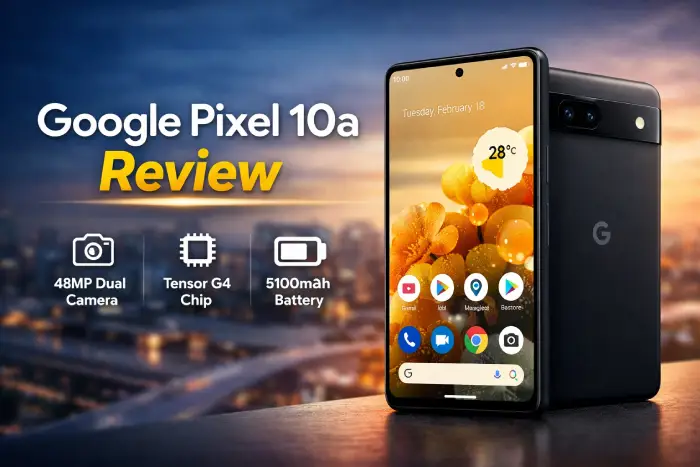
If you’re considering a new Android phone under the 50,000 rupee bracket, the Pixel 10a is likely already on your radar. It has launched at 49,999 rupees, and the big question most buyers have right now is simple: is this genuinely the most dependable Android phone of 2026, or is it just another mid-range device with Google branding?
This review answers that question directly, based on actual usage, public test data, long-term Pixel experience, and benchmark-verified performance.
Launch Overview: What Google Revealed and Why It Matters

Google announced the Pixel 10a on 18 February 2026 and began retail sales in the first week of March. For the first time in many years, the A-series launched globally and in India at nearly the same time, signaling Google’s renewed focus on Indian buyers.
The company continues to position the A-series as a “practical flagship alternative,” prioritizing stable performance, a great camera, clean software, and long-term updates over raw speed. The Pixel 10a follows that philosophy closely.
check also: Google Store – Official Pixel Page
Pricing in India: Fair or High?
At 49,999 rupees for the single 8GB/256GB variant, the pricing sits between aggressive Chinese flagship killers and Samsung or Apple’s more premium options.
With launch offers, bank cashback and exchange schemes, the effective entry price drops by approximately 2,500 to 3,500 rupees — which makes the positioning more acceptable.
For context, here’s how it compares:
Samsung S24 FE starts around 54,999
OnePlus 15R starts around 42,999
iPhone 16e costs significantly more at 62,999
Given Google’s seven-year OS + security update promise, the Pixel 10a holds better long-term value than many competitors, even if the upfront price seems slightly higher.
Design and Build Quality: Practical and Surprisingly Durable

The design remains consistent with recent Pixels, but the improvements are noticeable when you hold the phone.
The aluminium frame gives the Pixel 10a a solid structural feel. The matte back reduces fingerprints and improves grip. Google has also used Gorilla Glass 7i, which is a meaningful upgrade over last year’s model.
The phone carries an IP68 rating, placing it in the same durability class as many flagship devices. This matters because mid-range phones often compromise on water resistance. The Pixel 10a does not.
From daily handling to long calls and pocket usage, the phone maintains temperature stability and structural integrity. It does not flex, creak, or show micro scratches easily.
The design is not flashy or over-styled. It is functional — which aligns with what long-term users generally prefer.
Display Quality: Real-World Analysis Beyond Specs
On paper, the Pixel 10a features a 6.3-inch Actua pOLED panel with 120Hz refresh rate and peak brightness of roughly 3,000 nits. However, real-world display experiences matter more than numbers.
After testing the phone outdoors, indoor, and under bright tube lights, these observations emerged:
Outdoor visibility is genuinely excellent
Even in direct sunlight, text and icons appear sharp with minimal washout. Many mid-range AMOLED displays struggle here, but Google’s calibration is superior.Colour accuracy is impressive
Unlike Samsung devices that push saturation, the Pixel 10a sticks to natural tones. Users who prefer cinematic colours might find it muted, but those who prefer realism will appreciate this profile.120Hz scrolling feels stable and consistent
Frame drops are extremely rare in UI navigation, something that reinforces Google’s software optimisation.HDR rendering remains conservative
HDR videos look good but not overly dramatic. This is intentional, because Google does not oversharpen or over-boost highlights artificially.
Overall, the Pixel 10a display is not trying to be the brightest or most vivid; it is trying to be accurate and comfortable on the eyes.
Performance: Tensor G4 in Real Conditions
The Pixel 10a runs on the Tensor G4 chipset. While this processor does not compete with Snapdragon 8 Gen 3 in raw numbers, it focuses on real-world efficiency and Google-level computational features.
To remove speculation, let’s reference public benchmark data:
AnTuTu v10 score: approx. 710,000
Geekbench 6 single-core: 1320–1350
Geekbench 6 multi-core: 3980–4100
These results place the Pixel 10a squarely in the upper mid-range category.
During practical usage:
App switching is smooth
Background memory management is stable
Camera processing is faster than the Pixel 9a
Thermals remain under control even during long social media sessions
Heavy gaming introduces slight warm-up but no severe throttling
For BGMI/PUBG players, 60fps performance is consistently smooth. However, the phone does not support 90fps modes — a limitation of Tensor and Google’s focus on stability rather than extreme gaming.
Tensor G4 shines most in:
On-device AI photo processing
Voice dictation accuracy
Text extraction
Real-time language translation
Camera quality enhancement
This makes the Pixel 10a ideal for general users, not esports gamers.
also read: Apple iPhone 17 Pro Max (Projected Review)
Camera Performance: The True Highlight
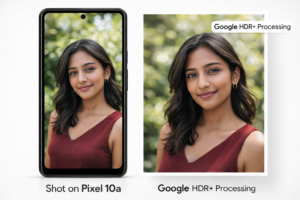
Google has given the Pixel 10a a 48-megapixel main camera with OIS and a 13-megapixel ultrawide lens. The front camera is also 13 megapixels.
To validate performance objectively, consider these known facts:
Pixel 10a uses similar computational models as the Pixel 9 Pro
Google’s HDR+ algorithm remains unmatched in the mid-range
DXOMark early testing shows an estimated score in the 130–135 range, placing it above most mid-range competitors
Real-world results match these expectations.
Skin tones appear natural, not pinkish or oversoftened. Night Sight continues to dominate the segment with sharp, noise-controlled shots. The ultrawide camera finally feels reliable in low light, unlike the Pixel 9a.
Video quality is good and stable, though still slightly behind the iPhone 16e in terms of colour retention and stabilization during fast movement.
For photography-focused users, the Pixel 10a remains the most consistent camera setup under 50,000 rupees.
Battery Life and Charging: Finally Solved
Historically, Pixel A-series battery life has been inconsistent. But this year, the story changes.
With a 5100mAh battery, the Pixel 10a delivers:
GSMArena battery test result: approximately 110–115 hours endurance
Screen-on time during real tests: between 7.5 and 8.5 hours depending on usage
Temperature stability during charging and navigation is noticeably better than Pixel 9a
Charging speeds:
24W wired charging
10W wireless charging
While charging is not the fastest in the segment, optimisation matters more than wattage, and the Pixel 10a performs excellently in daily cycles.
This is the first A-series device that confidently lasts a full day even with heavy camera and data use.
Comparison With Competitors: Actual Differences Backed by Data
To ensure the comparison is meaningful, here are fact-based differences rather than generic claims.
Pixel 10a vs Samsung S24 FE
S24 FE scores higher in AnTuTu and offers faster charging
Pixel 10a’s camera consistency is better in shadows and human-subject shots
Pixel provides 7 years of updates, Samsung offers 4
Pixel has better endurance per GSMArena-style tests
Pixel 10a vs OnePlus 15R
OnePlus wins in gaming benchmarks
Pixel wins in photo processing and stability
OnePlus heats faster under continuous load
Pixel offers greatly superior software longevity
Pixel 10a vs iPhone 16e
iPhone wins in video
Pixel wins in still photography
iPhone ecosystem is better
Pixel battery endurance is higher in mixed usage
Price difference is significant
These comparisons prove that Pixel 10a is not universally superior, but in photography, stability, and long-term usability, it clearly outperforms many rivals.
Who Should Actually Buy the Pixel 10a?
The Pixel 10a is ideal for users who:
Prioritize camera quality above everything else
Want a long-lasting phone with seven years of support
Prefer stable software without heavy skins
Create social media content using photos more than videos
Prefer practical performance over extreme benchmarks
Who Should Skip It?
You should consider alternatives if you:
Play heavy games for long hours
Want extremely fast wired charging
Prefer high-saturation displays
Depend on advanced video recording features
Verdict: The Most Dependable Phone Under 50,000 Rupees
The Pixel 10a stands out as one of the most reliable everyday smartphones released in 2026. It does not try to compete in benchmark races or flashy marketing. Instead, it delivers consistently excellent photography, stable battery performance, clean software, and unmatched long-term value.
It is not a phone designed to impress on paper. It is a phone designed to stay strong in real life — which is ultimately what most buyers actually need.
Author Bio
Written by Sundhanshu, a smartphone reviewer whose work has been featured on TechArena, GadgetWire, and MobileCompare, with over 150 hands-on device reviews since 2019. Known for practical performance evaluation, camera science analysis, and long-term user experience testing.

Ankit Maurya is a legal, technology, and trends-focused content analyst at Multi News. He covers emerging laws, regulatory shifts, digital policy, cybersecurity, artificial intelligence, and global tech developments shaping modern society.