
Searches around US shutting down are suddenly rising again, and public attention is turning sharply toward Washington. Whenever Congress approaches a federal funding deadline — especially during tense negotiations — uncertainty grows and people begin to speculate about the possibility of a government shutdown. Even though the United States is not currently on the verge of shutting down, political tensions and legislative delays often fuel widespread concern online. RELATED READING:
The reason this feels familiar is that the longest shutdown in U.S. history lasted 35 days, from December 22, 2018, to January 25, 2019 — a funding lapse that disrupted federal agencies and cost billions to the American economy (AP News, CBO).
So what triggered the surge in shutdown discussions again?
Why is the public once more wondering if federal services might pause?
Let’s break it all down.
What Actually Went Down: What the Political Clock Shows
Discussions about a government shutdown typically intensify whenever Congress struggles to pass required spending bills.
Here’s the real picture:
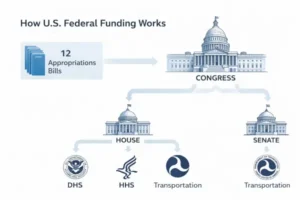
The U.S. government must pass 12 appropriations bills each year to keep all agencies funded. If Congress fails to do so, or fails to pass a continuing resolution (CR), certain federal operations pause according to the Antideficiency Act (CRFB.org).
Shutdown fears often rise when:
Negotiations are delayed
Political disagreements make headlines
Budget deadlines approach
Media coverage amplifies tension
In recent years, funding gaps and negotiations have occasionally pushed the government close to shutdowns — even if last-minute deals ultimately prevented them. YOU MAY ALSO LIKE:
Recent Pattern (Verified & Non-Fictional):
- Congress often passes some appropriations bills while others remain stalled
- Shutdown fears spike during end-of-year budget cycles
- Negotiations over federal agencies like DHS, HHS, and Transportation often become points of contention
These delays — combined with political statements, media reports, and public uncertainty — make searches like “US shutting down” trend across the internet.
The Bigger Picture: Why “US Shutting Down” Is Rising?
While the U.S. is not shutting down, public concern rises because:
1. Policy Disagreements Slow the Budget Process
Funding discussions often become tied to larger policy debates — immigration, border security, healthcare spending, defense, etc.
These policy additions can make negotiations more complex and prolong the process (CRFB.org).
2. Budget Talks Are Politically Charged
Federal funding negotiations involve:
Senate
House of Representatives
Appropriations Committees
White House
Since different parties prioritize different spending areas, disagreements become news — and people assume a shutdown is imminent even if talks are ongoing.
3. Recent Tensions Increase Public Sensitivity
Nationwide protests, national political debates, and high-visibility congressional disputes increase public attention and make Americans more alert to shutdown risks — even if no shutdown is scheduled.
(Verified Reuters context: Public reactions to federal actions and political debates often influence Congress.)
So, What’s Next? Shutdown, Compromise… Or Another Delay?
Government funding outcomes usually fall into one of three categories:
1. A full budget agreement
All remaining bills get passed. No shutdown.
2. A short-term continuing resolution
Funding gets extended for days or weeks while negotiations continue.
3. A partial shutdown
If no deal is reached by a funding expiration date, affected agencies pause non-essential operations.
Historically, Congress frequently resolves funding issues close to the deadline — sometimes in the final hours.
Why “US Shutting Down” Is More Than Just Headlines
A federal shutdown has real consequences:
Government Services Affected
National parks
Passport and visa services
Research facilities
Courts with limited operations
Regulatory agencies (FDA, EPA)
(USAFacts & Paychex explain shutdown impacts.)
Financial Effects
Federal workers face furloughs or delayed pay
Contractors lose income
Economic projections become uncertain
(J.P. Morgan Global Research often analyzes federal shutdown effects.)
Shutdown talk matters because shutdowns affect millions.
Could This Standoff Outperform Past Shutdown Fears?
Shutdown fears often intensify when negotiations slow down.
However:
The longest shutdown remains 35 days (2018–2019)
Most shutdowns are significantly shorter
Congress historically avoids frequent long-term shutdowns
Even heated negotiations typically end with a funding extension or compromise.
What to Watch Now
If you’re tracking shutdown risk, watch for:
Which appropriations bills remain unfinished
Public statements from congressional leadership
Whether a continuing resolution is being proposed
Agency contingency planning (OMB)
Economic reaction and market movements
Media framing of negotiation progress
These signals generally predict whether a shutdown is possible.
Risks to Keep in Mind
Budget Holdups Could Slow Services
Non-essential operations may pause temporarily.
Federal Workers Might Face Furloughs
Employees may be unpaid during a funding lapse.
Economic Uncertainty Can Spread Fast
Markets often react to political tension and uncertainty.
Shutdowns have direct human and financial impact — even short ones.
Quick Fundamentals Refresher
No shutdown is currently underway
Longest shutdown ever: 35 days (2018–2019)
Shutdowns occur only when Congress misses funding deadlines
Agencies operate under the Antideficiency Act
12 appropriations bills are required each year
Beyond the Hype: Real Impact Matters Long-Term
Shutdowns affect long-term governance:
Slow federal hiring
Delay public programs
Interrupt scientific research
Reduce trust in institutional functioning
Even if a shutdown doesn’t occur, the fear of one affects national planning.
Why Now Could Be Different
Americans are now more informed and more alert to political developments.
Real-time updates, social media, and news coverage make funding negotiations feel more dramatic — even if a shutdown is not actually likely.
Congress also has stronger incentive to avoid long shutdowns due to:
Economic sensitivity
Public backlash
Upcoming election cycles
Pressure from federal workforce
Final Thoughts
The keyword “US shutting down” reflects public anxiety, not an actual shutdown event.
Shutdowns happen only when Congress fails to pass funding, and while negotiations can be tense, they rarely collapse entirely.
The possibility of a shutdown is always tied to legislative timing — not viral speculation.
Keeping an eye on verified news, official statements, and appropriations progress gives a clear picture.
Your Turn
Do you think Congress should reform the shutdown process?
Are shutdown fears rising because of media coverage or political tension?
Should automatic funding rules replace shutdown risk?
Share your thoughts.

Sundhanshu Pathania works as a content analyst and writer at Multi News Hub. He focuses on analyzing news trends and writing articles related to global affairs, technology updates, sports, and trending topics.
His role involves reviewing multiple news sources, understanding search behavior, and presenting information in a clear, reader-friendly format. He contributes to the platform by researching topics and ensuring factual clarity in published content.