
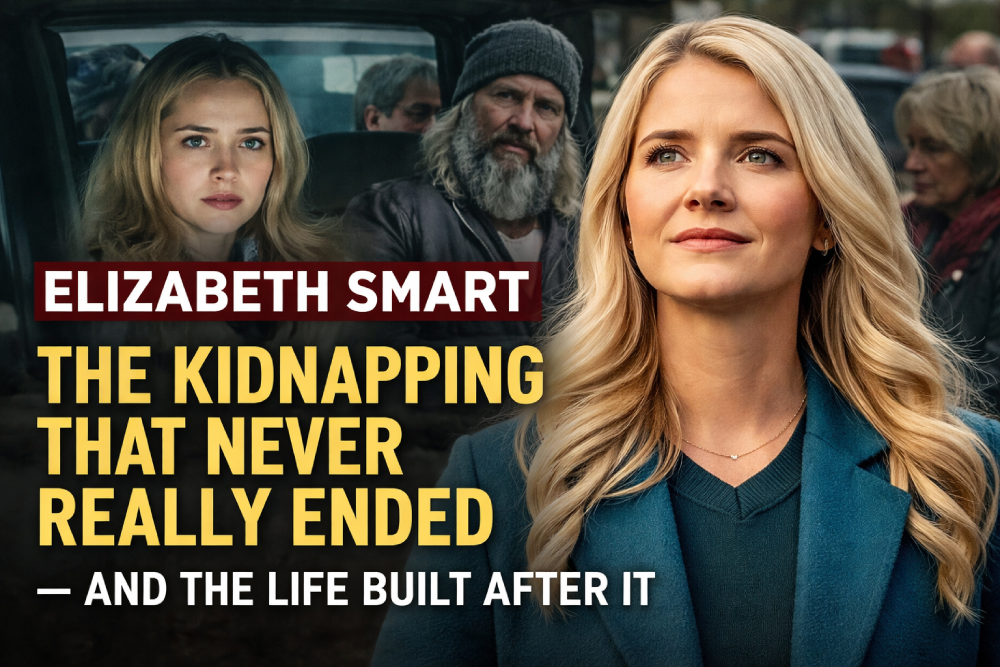
So this name keeps popping up again.
Elizabeth Smart.
People aren’t looking because they are sad. They’re searching because the story refuses to stay in the past. New documentaries, old clips resurfacing, courtroom footage circulating again. And honestly? Because her life after the kidnapping keeps evolving, and people want to know how someone lives after something like that.
Not survives. Lives.
Elizabeth Smart isn’t just “the girl who was kidnapped. That label followed her for years whether she wanted it or not. But it doesn’t explain the whole story. Not even close.
So let’s slow this down and walk through it. The real version. No TV-news polish.
The Night Everything Broke Open
June 5, 2002. Salt Lake City. Middle of the night.
Elizabeth Smart was 14 years old, asleep in her bedroom, when a man with a knife walked into her house. Her younger sister Mary Katherine, woke up and watched it happen. That detail still lands hard.
The man was Brian David Mitchell. A self-styled religious zealot. The kind of person neighbors remember later and say, Yeah…something always felt off.
Read more: Corporate Accountability in the Shadow Economy
He took Elizabeth from her home. Just like that.
For the next nine months she was gone.
Missing.
And not missing in some abstract way. Missing with her face everywhere. Missing with candlelight vigils. Missing with her parents on TV every night trying not to fall apart on camera.
People forget how chaotic those early months were. Tips flooding in. Sightings that went nowhere. Rumors. False hope. Real fear.
At one point some people quietly assumed the worst.
They were wrong.
How She Was Found (And Why It Was Complicated)
Elizabeth wasn’t hidden in some faraway place.
That’s the part that still messes with people.
She was moved around. Forced to live outdoors. Disguised. Brainwashed. Threatened constantly. Told her family didn’t want her. Told she’d be killed if she tried to escape.
Mitchell wasn’t alone. His wife Wanda Barzee helped him. That matters. This wasn’t a single-person crime. It was a system of control.
In March 2003, police in Sandy, Utah, spotted Mitchell walking with Elizabeth and Barzee. Elizabeth was wearing a veil. She didn’t speak up right away.
That detail has been judged endlessly. And misunderstood just as often.
Trauma doesn’t look heroic in real time.
Eventually, police realized who she was. She was rescued. Alive.
After 287 days.
The Courtroom Years Nobody Likes to Rewatch
The legal process dragged on for years.
Mitchell wasn’t immediately convicted. There were delays. Mental competency hearings. More delays. Survivors don’t get neat timelines.
Elizabeth had to testify. Again and again. Relive it. Answer questions no teenager should ever hear let alone respond to under oath.
Mitchell was eventually convicted in 2011 and sentenced to life in prison without parole.
Barzee was convicted earlier, served time, and was released in 2018. That release reopened wounds people thought had scarred over.
Elizabeth has spoken openly about how difficult that was. Justice doesn’t always feel finished.
Read more: Silver Price Surges Again: Is ₹2.60 Lakh per Kg the Next Big Target?
The Part People Don’t Expect: Elizabeth Smart Today

Here’s where the story shifts.
Elizabeth Smart didn’t disappear into privacy forever. She could have. No one would’ve blamed her.
Instead, she went the opposite direction.
She became an activist. A public speaker. An advocate for missing children, abuse survivors, and trauma education.
She founded the Elizabeth Smart Foundation focusing on prevention, recovery, and legislative reform.
She worked with law enforcement. With policymakers. With educators.
And yes, she built a personal life too.
She got married. She has children. She talks openly about motherhood after trauma — something people don’t often hear about.
Not the inspirational-poster version. The complicated one.
Why People Still Google Her
Look at the search terms:
- Elizabeth Smart kidnapping
- Who kidnapped Elizabeth Smart
- Elizabeth Smart today
- Elizabeth Smart documentary
- Elizabeth Smart net worth
That mix tells you something.
People are trying to understand how trauma echoes across decades. They’re trying to connect the scared teenager with the composed woman speaking on stages today.
And some are just trying to make sense of survival. What it costs. What it changes.
About That Net Worth Question
This comes up a lot. And it’s uncomfortable, but let’s be clear.
Elizabeth Smart’s income comes from:
- Speaking engagements
- Books and media work
- Advocacy and consulting
She is not wealthy because of the crime. There was no exploitation payout. No sensational settlement that made her rich.
If anything, she’s been careful about how her story is used. That restraint matters.
Documentaries, Movies, and Retelling the Story
There’s the 2003 TV movie The Elizabeth Smart Story. Later documentaries. Interviews. Specials.
Some are handled responsibly. Some… less so.
Elizabeth has spoken about how strange it is to watch actors play moments she still feels in her body.
That’s a reminder: true crime is entertainment for viewers, but lived reality for survivors.
Why Her Story Still Matters
Not because it’s shocking.
But because it exposes uncomfortable truths:
- Kidnapping doesn’t always look dramatic
- Victims don’t always escape when outsiders think they should
- Survival isn’t a clean arc
- “Why didn’t she run?” is the wrong question
Read more: Trump Economy 2025: Why Millions of Americans Still Feel Financial Pressure
Elizabeth Smart changed how law enforcement talks about victim behavior. Her case is literally used in training now.
That’s impact.
Final Thought
Elizabeth Smart doesn’t exist to close a story for anyone else.
She survived something most people only encounter through headlines and she did it without choosing the role the public often assigns to survivors. She didn’t promise inspiration. She didn’t turn pain into spectacle. She didn’t offer neat lessons.
What she did do verifiably, over years is show that recovery isn’t linear silence isn’t weakness, and speaking out is a decision, not an obligation.
Her continued presence isn’t about reliving the crime. It’s about shaping what happens after one. Policy. Education. Language. Accountability.
That why her name still appears in searches and conversations not because the kidnapping defines her, but because her work keeps intersecting with how society understands trauma survival, and responsibility.
And that’s not a story that ends cleanly. It just keeps moving forward.

Sundhanshu Pathania works as a content analyst and writer at Multi News Hub. He focuses on analyzing news trends and writing articles related to global affairs, technology updates, sports, and trending topics.
His role involves reviewing multiple news sources, understanding search behavior, and presenting information in a clear, reader-friendly format. He contributes to the platform by researching topics and ensuring factual clarity in published content.