
Why Everyone Is Suddenly Searching “Insurrection Act”
If you look at search data right now, one thing is clear:
People aren’t casually curious.
They’re asking things like:
- Can a president invoke the Insurrection Act?
- Was it used during elections?
- Did Trump try to use it?
- Is this even constitutional?
- What does the actual text say?
That’s not normal civic trivia. That’s public anxiety mixed with legal uncertainty.
The Insurrection Act is one of those laws most Americans never think about — until they really, really need to. Or fear it might be used.
And once you read it carefully, you understand why.
What the Insurrection Act Actually Is
The Insurrection Act of 1807 is a federal law that allows the President of the United States to deploy U.S. military forces inside the country.
Yes inside the United States.
Not for war abroad.
Not for training.
For domestic law enforcement, under specific conditions.
It is codified today in Title 10 of the U.S. Code, Sections 251–255.
This law exists as an exception to the Posse Comitatus Act, which normally forbids the military from acting as police.
So when the Insurrection Act is invoked, something fundamental shifts.
Source: Brennan Center legal analysis:
Why the Law Was Created in the First Place (1807 Context Matters)
To understand this law, you have to go back to the early United States — a country that barely trusted standing armies.
In the early 1800s:
- State militias were unreliable
- Federal authority was weak
- Rebellions were not theoretical (Shays’ Rebellion, Whiskey Rebellion)
Congress feared states losing control or worse, refusing to enforce federal law.
So in 1807, lawmakers passed a law saying, in effect:
If states cannot or will not protect constitutional rights or enforce federal law, the president may step in with force.
That’s the DNA of the Insurrection Act.
Not tyranny.
Not benevolence.
Emergency federal override.
read more: Pentagon Moves to Reduce Senator Mark Kelly’s Military Rank: What’s Happening and Why It Matters
What the Insurrection Act Allows — In Plain English
Under the Act, the president may deploy the military when:
1. A State Requests Help
If a governor asks for federal military assistance to suppress unrest.
2. Federal Law Cannot Be Enforced
If “unlawful obstructions” or rebellion make it impossible to enforce federal law through normal means.
3. Constitutional Rights Are Being Denied
If a state fails to protect constitutional rights and refuses or is unable to act.
This third provision is the most controversial — and the most powerful.
Is the Insurrection Act in the Constitution?
Short answer: No.
Long answer: It is derived from constitutional powers, not explicitly written in the Constitution.
The legal basis comes from:
- Article I, Section 8 — Congress’ power to call forth the militia
- Article II — the president as commander-in-chief
The Supreme Court has never ruled the Act unconstitutional.
In fact, courts historically give the president wide discretion once the Act is invoked.
That discretion — not the text — is what alarms civil liberties experts.
Has the Insurrection Act Actually Been Used? Yes — Repeatedly
This is not a dusty, unused relic.
Key Historical Uses
1957 – Little Rock, Arkansas
President Eisenhower deployed the 101st Airborne to enforce school desegregation.
1960s – Civil Rights Era
Used multiple times to protect Black students and enforce federal court orders.
1992 – Los Angeles Riots
President George H. W. Bush invoked the Act after Rodney King verdict unrest.
In all cases, state authority had collapsed or requested help.
Insurrection Act 1992: Why This Search Keeps Coming Back
People search “Insurrection Act 1992” because it’s the most modern, clear precedent.
In Los Angeles:
- Local police were overwhelmed
- National Guard was activated
- Federal troops followed
The public largely supported the move because violence was visible and immediate.
That context matters.
Because later discussions — especially after 2020 — lacked that clarity.
read more: Trump Economy 2025: Why Millions of Americans Still Feel Financial Pressure
The Trump Question: Could He Invoke It? Did He Try?
This is where the law stopped being academic.
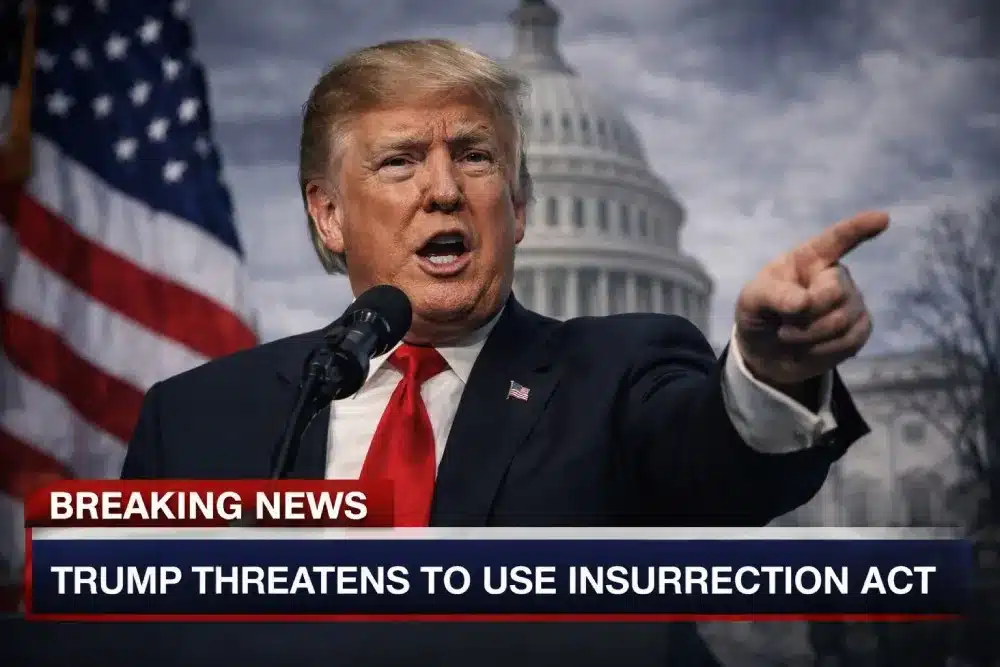
In June 2020, amid nationwide protests after George Floyd’s killing, President Donald Trump publicly considered invoking the Insurrection Act.
He did not formally invoke it.
But he openly threatened to.
Defense leaders at the time expressed discomfort.
Former Secretary of Defense Mark Esper stated he opposed using active-duty troops for domestic law enforcement.
This moment permanently changed how Americans view the Act.
It was no longer historical.
It was political.
Can the Insurrection Act Be Used During Elections?
Legally? Yes.
Practically? Extremely dangerous territory.
The Act does not exclude elections from its scope.
That’s why election-related searches surged.
Experts warn that invoking it around elections could:
- Undermine democratic legitimacy
- Chill voter participation
- Trigger constitutional crises
There is no automatic congressional approval required.
No real-time judicial veto.
That’s the issue.
Insurrection Act vs Posse Comitatus: Why This Exception Is Huge
The Posse Comitatus Act (1878) bans military policing.
The Insurrection Act overrides it.
That means:
- Soldiers can detain civilians
- Military can enforce civilian law
- Normal federal-state boundaries blur
Legal scholars describe this as “constitutional hard power”.
Used rarely.
Feared widely.
check more: Latest on Trump signing the bill to release Epstein files
Why Civil Liberties Groups Are Alarmed
The concern isn’t just misuse.
It’s lack of guardrails.
- No clear definition of “insurrection”
- No time limits
- No mandatory congressional review
In a polarized political climate, that’s not a small problem.
Why This Law Is Trending Again Right Now
This isn’t random.
Three forces are colliding:
- Political polarization
- Election integrity fears
- Public protest normalization
The Insurrection Act sits at the intersection of all three.
It represents ultimate federal authority — and the risk of its overreach.
Final Thoughts
The Insurrection Act isn’t evil.
It isn’t heroic.
It’s a tool.
A sharp one.
History shows it can protect rights — and threaten them.
What matters isn’t just who can invoke it.
It’s when, why, and whether the public trusts the reason.
And right now?
That trust is fragile.
Very fragile.

Sundhanshu Pathania works as a content analyst and writer at Multi News Hub. He focuses on analyzing news trends and writing articles related to global affairs, technology updates, sports, and trending topics.
His role involves reviewing multiple news sources, understanding search behavior, and presenting information in a clear, reader-friendly format. He contributes to the platform by researching topics and ensuring factual clarity in published content.